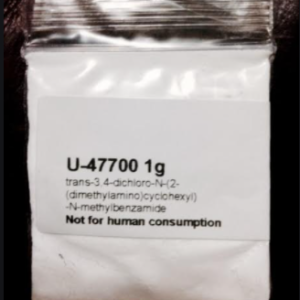

Buy U-47700 Online Research and Forensic Overview
U-47700 is a potent synthetic opioid developed during pharmaceutical research but never approved for therapeutic use. Because of its high potency, overdose risk, and international controls, it should be handled only in appropriately licensed and equipped research institutions.
Chemical Formula
| Property | Information |
|---|---|
| Common name | U-47700 |
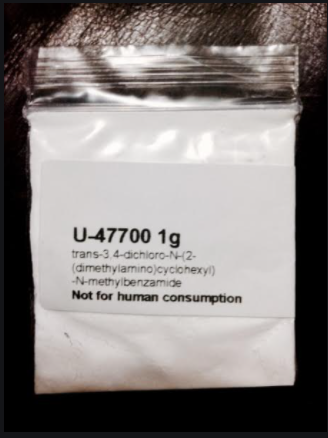
| Systematic/IUPAC name | 3,4-dichloro-N-[(1S,2S)-2-(dimethylamino)cyclohexyl]-N-methylbenzamide |
| Molecular formula | C₁₆H₂₂Cl₂N₂O |
| Molecular weight | 329.26 g/mol |
| CAS numbers | 98717-01-2; 82657-23-6 |
| Substance class | Synthetic opioid |
| Primary pharmacological target | μ-opioid receptor (MOR) |
Chemical Composition
Buy U-47700 contains:
- 16 carbon atoms
- 22 hydrogen atoms
- 2 chlorine atoms
- 2 nitrogen atoms
- 1 oxygen atom
Its chemical structure is based on a dichlorobenzamide scaffold connected to a substituted cyclohexylamine moiety. The internationally controlled form is stereochemically defined, with two chiral centers.
Storage and Physicochemical Properties
Published sources describe U-47700 as an alkaline and lipophilic compound with increased solubility in acidic conditions. Physicochemical characterization remains less extensive than for many established pharmaceuticals.
For licensed laboratory reference materials, suppliers may specify storage at −20 °C; however, the exact storage conditions should always follow the manufacturer’s Certificate of Analysis/SDS and the institution’s controlled-substance procedures.
General institutional precautions:
- Store in secured, access-controlled controlled-substance storage.
- Maintain inventory, chain-of-custody, and usage records.
- Use appropriate chemical and opioid-exposure risk controls.
- Avoid creating unnecessary airborne powder exposure.
- Follow institutional spill, waste, and emergency procedures.
Research Uses
U-47700 has legitimate scientific relevance primarily as a research and analytical reference substance, including:
- μ-opioid receptor pharmacology research.
- Structure–activity relationship studies of synthetic opioids.
- Metabolism and biotransformation research.
- Toxicology and postmortem interpretation.
- Development and validation of analytical detection methods.
- Evaluation of opioid-receptor activity and novel synthetic opioid analogues.
It was developed as a potential analgesic, but development was abandoned, and it was never approved for medical use.
Analytical & Forensic Applications
U-47700 is particularly important in forensic toxicology because of its involvement in illicit synthetic-opioid markets.
Research applications include:
- LC-MS/MS method development and validation.
- LC-HRMS screening and non-targeted toxicology.
- GC-MS identification and confirmation.
- Analysis of biological matrices such as blood and urine.
- Postmortem toxicology investigations.
- Metabolite identification and confirmation.
- Use of deuterated internal standards for quantitative analysis.
For example, deuterated U-47700 standards are marketed specifically for GC-MS and LC-MS quantification in forensic and research applications.
Positive Scientific Uses
Despite having no approved therapeutic use, U-47700 can contribute to science when used legally and responsibly.
Potential scientific value includes:
- Improving detection of emerging synthetic opioids.
- Supporting forensic laboratories in identifying overdose-related substances.
- Helping researchers understand synthetic-opioid metabolism.
- Improving analytical reference libraries.
- Supporting opioid receptor pharmacology research.
- Assisting public-health surveillance of novel psychoactive substances.
These uses are scientific and institutional, not clinical or consumer applications.
Licensed Institutional Handling & Distribution
Because U-47700 is internationally controlled, handling and distribution should be restricted to institutions and laboratories holding the relevant authorization.
Typical requirements may include:
- Controlled-substance registration or licensing.
- Institutional approval and documented research purpose.
- Secure storage and restricted access.
- Controlled inventory and chain-of-custody records.
- Appropriate analytical or research facilities.
- Authorization for import/export where applicable.
- Procurement through authorized scientific suppliers.
The precise requirements depend on the jurisdiction and institutional framework. Internationally, U-47700 is listed in Schedule I of the 1961 Single Convention on Narcotic Drugs.
Legal Status & Regulatory Controls
International: U-47700 was placed in Schedule I of the 1961 Single Convention on Narcotic Drugs in 2017.
United States: U-47700 is a DEA Schedule I controlled substance.
Other countries: National controls vary, but many jurisdictions have adopted strict controls. A researcher should verify the current national regulations in the country where the laboratory operates before acquiring, possessing, importing, exporting, or distributing the substance.
Frequently Asked Questions (FAQ)
Is U-47700 approved as a medicine?
No. It has not been approved for medical use.
What type of compound is U-47700?
It is a potent synthetic opioid acting primarily at the μ-opioid receptor.
What is its molecular formula?
C₁₆H₂₂Cl₂N₂O.
Why is it important in forensic science?
It is relevant to the detection, identification, metabolism, and investigation of novel synthetic opioids in forensic and toxicological samples.
Can a university laboratory legally work with U-47700?
Potentially, but only if the institution and researchers meet the applicable controlled-substance licensing, security, procurement, and recordkeeping requirements.
Can U-47700 be distributed commercially as a general research chemical?
Not lawfully as unrestricted material in jurisdictions where it is controlled. Distribution must comply with applicable national and international controlled-substance regulations.
Does U-47700 have scientific value?
Yes. Its principal scientific value lies in controlled pharmacology, analytical chemistry, forensic toxicology, metabolism studies, and reference-standard applications.
Important: Because U-47700 is a highly potent controlled opioid, I can help with its chemistry, analytical characterization, toxicology, receptor pharmacology, metabolism, forensic detection, or regulatory research, but I would not provide instructions for illicit synthesis, recreational use, or methods to evade drug controls.
| Quantity | 50 Grams, 100 Grams, 250 Grams, 500 Grams |
|---|
Related products
Stimulants
Research Chemicals
Stimulants
4-FMA
Research Chemicals
Stimulants
Stimulants
Stimulants